
VFR: flying by visual reference, within clear rules
VFR stands for Visual Flight Rules. Pilots use external visual references to conduct the flight and keep a lookout for traffic, terrain and obstacles. GPS, instruments and ATS support the task, but do not turn a VFR flight into an instrument flight.
VFR describes the flight rules; VMC describes the weather conditions. VMC are defined by visibility and distance from cloud. IFR means Instrument Flight Rules: an IFR flight can also take place in good weather. Ordinary VFR requires the applicable VMC along the route, as well as compliance with airspace, height, clearance and aircraft limitations.
Put the numbers in the right places: 5 or 8 km visibility; normally 1,500 m horizontally and 1,000 ft vertically from cloud; 250 kt IAS below 10,000 ft in Classes C–G; 140 kt IAS as the special VFR speed limit. The 8 refers to kilometres: 8,000 ft is not the general VMC table threshold.
This guide covers the SERA framework and Italian RAIT provisions for general aviation. Microlights/VDS, special operations and individual aerodromes also require their specific rules. References checked on 4 November 2026; consult current AIP, NOTAM and weather information before flight.
1. Start with altitude, visibility and ceiling
- AMSL: altitude above mean sea level. AGL: height above the terrain below. Over terrain at 2,500 ft AMSL, an aircraft at 3,300 ft AMSL is approximately 800 ft AGL.
- FL: flight level, referenced to standard pressure, 1013.25 hPa. FL 100 and 10,000 ft on QNH are not always the same surface.
- IAS: indicated airspeed, different from groundspeed and TAS. The 250 and 140 kt limitations discussed here are IAS.
- Flight visibility: assessed by the pilot from the cockpit; ground visibility: reported for the aerodrome. One METAR does not describe the entire route.
- Ceiling: the height of the base of the lowest cloud layer covering more than half the sky, below 20,000 ft. In a briefing, pay particular attention to BKN, OVC and any reported vertical visibility; not every cloud base constitutes a ceiling.
For more detail, see QNH, altitude and flight levels and METAR cloud cover, base and ceiling.
2. VMC minima at a glance
Identify the airspace class first, then the altitude band. The low band extends to the higher of 3,000 ft AMSL or 1,000 ft above terrain. Cloud distances are minima and must be maintained together with the required visibility.
| Altitude band | Classes | Flight visibility | Distance from cloud |
|---|---|---|---|
| At or above 10,000 ft AMSL* | B, C, D, E, F, G | 8 km | 1,500 m horizontally and 300 m (1,000 ft) vertically |
| Below 10,000 ft AMSL*, above the low band | B, C, D, E, F, G | 5 km | 1,500 m horizontally and 300 m (1,000 ft) vertically |
| Below the upper threshold*, within the low band (boundary included) | B, C, D, E | 5 km | 1,500 m horizontally and 300 m (1,000 ft) vertically |
| Below the upper threshold*, within the low band (boundary included) | F, G | 5 km, subject to the daytime reductions below | Clear of cloud, with the surface in sight |
* Transition: when the transition altitude is below 10,000 ft AMSL, use FL 100 instead of 10,000 ft in the VMC table. This is a weather-table note; do not automatically apply it to every other rule mentioning 10,000 ft.
Class A: ordinary VFR is not permitted. Its inclusion in the regulatory VMC table for guidance does not authorise VFR entry.
Understanding the low band
Over terrain at 500 ft AMSL, the higher boundary is 3,000 ft AMSL. Over terrain at 4,000 ft AMSL, it becomes 5,000 ft AMSL, or 1,000 ft above terrain. At 4,800 ft AMSL in Class G, you can therefore be in the low band: being above 3,000 ft AMSL alone does not identify the correct row.
3. Cloud clearance: horizontal and vertical
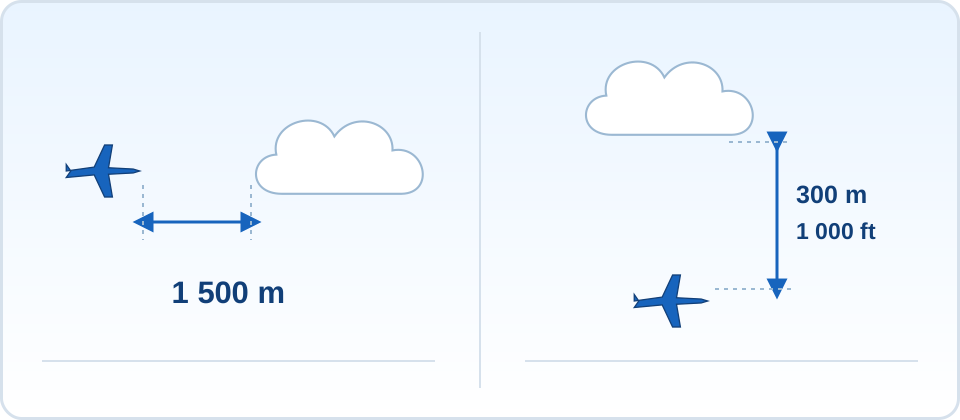
The 1,000 ft is neither altitude above sea level nor height above the ground: it is vertical distance from cloud when flying above or below it. When passing alongside cloud, the horizontal margin is 1,500 m. These describe vertical and lateral separation; you do not also need a 1,500 m lateral displacement from a layer above or below which you already have the required vertical clearance.
For example, a uniform cloud base at 4,500 ft AMSL and an aircraft at 3,800 ft AMSL leave 700 ft below the layer: insufficient where 1,000 ft is required. Descending is an option only if terrain, obstacles, airspace and all other limits can still be respected.
4. Reduced visibility in Italy and the 140 kt condition
In Class F or G within the low band, by day, RAIT permits flight visibility down to 1,500 m under the specified conditions: 140 kt IAS or less, at a speed allowing timely detection of traffic and obstacles, or the particular low-traffic-encounter circumstances described in the rule. The aircraft must remain clear of cloud with the surface in sight.
Helicopters may operate down to 800 m, manoeuvring at a speed that allows timely detection and avoidance. These are conditional provisions, not the default for every Class G flight. The reductions do not apply at night.
1,500 m does not provide unlimited reaction time. At 140 kt, an aircraft travels about 72 m per second: 1,500 m represents roughly 21 seconds of forward travel, and less time against oncoming traffic. This is a geometric illustration, not a guaranteed operational margin.
This reduced-visibility provision in F/G is different from special VFR, which applies within a control zone and requires ATC clearance.
5. Speed: 250 kt, 140 kt and transonic flight
- 250 kt IAS below 10,000 ft AMSL: applies to VFR in Classes C, D, E, F and G, except for competent-authority approvals for aircraft types unable to maintain it for technical or safety reasons. Class B has no such general SERA.6001 speed limit; other applicable limits still matter.
- 140 kt IAS or less: the special VFR limit and a condition of the daytime visibility reduction described above. A safe speed for the actual circumstances may be considerably lower.
- Transonic and supersonic: VFR at these speeds requires competent-authority authorisation. There is no single speed in knots replacing this restriction; Mach also depends on temperature.
These are separate limits, not recommended cruising speeds. Respect the AFM/POH, aircraft configuration, turbulence limits, published procedures and applicable instructions. The 250 kt rule specifies below 10,000 ft AMSL; the VMC table’s FL 100 note is a separate issue.
6. What is special VFR (SVFR)?
Special VFR allows a visual flight within a control zone (CTR) in conditions below ordinary VMC, with explicit ATC clearance. It does not permit flight inside cloud, or continued flight outside the CTR in conditions below the applicable minima.
| Responsibility | Ordinary SVFR conditions |
|---|---|
| Pilot, in flight | Clear of cloud; surface in sight; flight visibility at least 1,500 m (helicopters 800 m); speed 140 kt IAS or less, appropriate to the conditions. |
| ATC, for take-off, landing or entry into the aerodrome traffic circuit within a CTR | Ground visibility at least 1,500 m (helicopters 800 m) and ceiling at least 600 ft. |
| Time of operation | By day unless otherwise permitted by the competent authority. Italy has specific provisions for helicopters at night. |
Crossing a CTR: the aerodrome ceiling and ground-visibility thresholds above apply to the listed aerodrome operations; 600 ft is not a universal ceiling requirement for every transit. The pilot must still meet the in-flight SVFR conditions, obtain clearance and, in Italy, report flight visibility to ATC. Where an aerodrome has several visibility measurements, RAIT uses the minimum measured visibility for the aerodrome SVFR clearance.
An ordinary clearance, radio contact or a transponder code is not an SVFR clearance. Approval also depends on traffic and procedures; it is not guaranteed. If you cannot meet the conditions, say so before entry and choose a viable alternative.
7. Check flight minima and aerodrome minima separately
- Aerodrome within a CTR: without the clearance provided for in SERA.5005(b), do not take off, land or enter the ATZ/traffic circuit when the ceiling is below 1,500 ft or ground visibility below 5 km. SVFR operations must also meet the conditions in the preceding section.
- Italian aerodrome outside a CTR, by day: RAIT.5005(b) specifies at least 600 ft ceiling and 1,500 m ground visibility (helicopters 800 m), using the minimum measured visibility. The applicable reduced-flight-visibility conditions must also be satisfied.
An aerodrome threshold does not remove in-flight minima. An ATZ is not necessarily a CTR; outside a CTR, requesting “special VFR” does not generally solve a weather limitation.
8. Minimum heights and the upper VFR limit
Except when necessary for take-off or landing, or with competent-authority permission, SERA.5005(f) requires:
- Over congested areas of cities, towns or settlements, or open-air assemblies: at least 1,000 ft above the highest obstacle within 600 m of the aircraft.
- Elsewhere: at least 500 ft above ground or water, or 500 ft above the highest obstacle within a 150 m radius.
Protection of people and property, local restrictions and national rules also apply. In Italy, from 1 June to 30 September, the minimum over beaches within 100 m on either side of the coastline is 1,000 ft, subject to the RAIT exceptions.
FL 195: VFR above this level is normally prohibited, with regulated exceptions for reserved airspace or authorisations up to FL 285. Where 1,000 ft RVSM vertical separation is applied above FL 290, VFR above FL 285 must not be authorised. None of this makes every lower level automatically available: airspace classification and clearances still govern.
9. Cruising levels: Italy’s particular track sectors
In level cruise above 3,000 ft above ground or water, use a level appropriate to track unless a clearance or competent-authority provision specifies otherwise. Italy’s RAIT table uses the following magnetic track sectors:
| Magnetic track | RAIT VFR series |
|---|---|
| 090°–269° | Odd thousands + 500 ft: for example 3,500, 5,500, 7,500 ft; when operating at flight levels, FL 035, FL 055, FL 075… |
| 270°–089° | Even thousands + 500 ft: for example 4,500, 6,500, 8,500 ft; when operating at flight levels, FL 045, FL 065, FL 085… |
These illustrate the series, not levels that are always available. Use QNH altitudes or flight levels according to transition procedures and the AIP; check terrain, cloud and airspace. Magnetic track, rather than simply heading, determines the sector. Do not automatically import another country’s 000°–179° split into Italy.
10. Night VFR: what changes?
RAIT requires an appropriately qualified pilot, a suitable aircraft and aerodromes open to night VFR. A flight plan is required when leaving the vicinity of an aerodrome; establish and maintain two-way communication on the appropriate ATS channel when available.
- VMC minima apply, with a ceiling of at least 1,500 ft; daytime visibility reductions to 1,500/800 m do not apply.
- Within the low band in Classes B–G, continuous sight of the surface is required.
- In mountainous areas in Italy: at least 8 km visibility; for aeroplanes, 3,000 m horizontally and 2,000 ft vertically from cloud. HEMS/EMS operations have their own provisions.
- Night aerodrome minima include 1,500 ft ceiling and 5 km ground visibility, or 8 km at mountain aerodromes identified in the AIP.
- Use State-established night minimum flight altitudes. Where none are established, SERA specifies 2,000 ft above the highest obstacle within 8 km over high or mountainous terrain, and 1,000 ft within 8 km elsewhere, subject to the stated exceptions.
For ATC-cleared helicopter SVFR at night in Italy, RAIT requires clear of cloud, surface in sight, visibility at least 3 km and cloud base at least 1,500 ft. The SERA 140 kt IAS limit remains, with a lower speed as conditions require. Do not extend this permission to aeroplanes.
Also check RAIT equipment requirements (radio, altitude-reporting transponder and ELT), procedures and operational limitations. Meeting one numerical threshold does not, by itself, establish that night flight is permitted.
11. Four situations to make the rules concrete
- Class D at 2,000 ft AMSL, 6 km visibility: visibility alone is insufficient. You also need 1,500 m horizontal and 1,000 ft vertical cloud clearance, plus clearance.
- Class G over low terrain, 2,000 ft AMSL and 4 km visibility by day: you are in the low band, but must check all Italian reduced-visibility conditions. “Class G” alone does not answer the question.
- FL 105, above the VMC threshold, with 6 km visibility: the lower band’s 5 km does not suffice; the upper row requires 8 km.
- CTR aerodrome reporting 3 km and a 1,000 ft ceiling: ordinary aerodrome minima are not met. SVFR may be considered if all conditions and procedures allow it and ATC grants clearance; do not enter on the strength of a request alone.
12. A practical pre-flight sequence
- Plan the route and alternatives, checking classes, CTRs/ATZs, RMZs/TMZs, heights and restrictions.
- Read METARs, TAFs and en-route information: visibility, cloud, significant weather, terrain and forecast changes.
- Select the correct VMC row for each segment and check aerodrome minima separately.
- Compare possible cruising levels with obstacles, cloud clearance, transition procedures and track rules.
- Check speeds, endurance, remaining daylight, qualifications, equipment and required clearances.
- Set personal margins and a decision point for diverting, turning back or landing before your options narrow.
Regulatory minima are a lower boundary, not a target. Haze, low sun, featureless water, mountains and deteriorating weather can make conditions unsuitable even above the numerical minima.
Continue with METARs and TAFs, VFR flight plans in Italy and VFR planning.